
By Duncan Carpenter, Head of Securities Lending Post Trade & Member, UK Accelerated Settlement Taskforce
T+1 is coming to the EU, UK and Switzerland in October 2027. That much is confirmed. But the firms treating it as the destination are missing the bigger picture.
I am often asked what T+1 will actually require of Securities Lending operations. The honest answer is: considerably more than many firms currently have in place. The settlement window compresses by 50% relative to T+2. Firms that rely on manual processes, or that think they can staff their way through cut-offs, will find the arithmetic does not work.
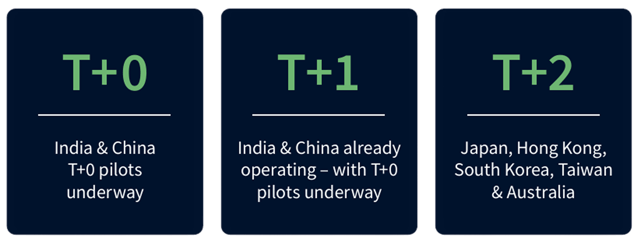
But I am also asked: what comes after T+1? And here the bigger picture is already clear, even if the timeline to getting there is not. India and China are running T+1 for equities today, with T+0 pilots already underway. T+1 is a waypoint on the journey to T+0, as Andrew Douglas, Chair of the UK’s Accelerated Settlement Taskforce, noted in Pirum’s recent industry webinar. Firms building their infrastructure to just meet a T+1 deadline – rather than to operate in a T+0 world – will face the same investment decision again, sooner than they think and under greater pressure.
Source: Pirum APAC White Paper, 2025
What T+1 is asking of your operations
Following North America's transition to T+1, a post-go-live survey found back-office staffing costs rose by 16-18% at firms that had not automated ahead of the transition. That's challenging enough, but the reality is that no manual process survives in a T+0 world.
The infrastructure that enables compliance at T+1 must already include automated pre-matching of Securities Lending instructions on trade date, automated recalls and return instruction flows, real-time visibility into trade status throughout the pre-settlement phase, and the use of triparty tools to forecast funding and position needs. These are the architectural baseline for any settlement environment that runs faster than T+2. Firms that treat them as optional will find out why.
The firms that implement these capabilities for T+1 today will not face T+0 as a transformation programme. They will face it as a configuration exercise.
The infrastructure premium and the AI case
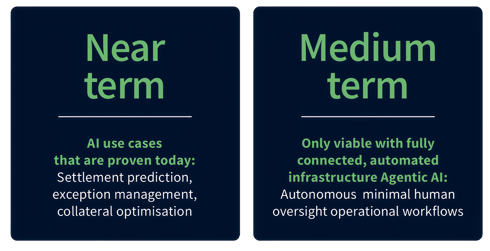
Moreover, the gap between firms with connected automation infrastructure and those without widens with every passing quarter. The connected data infrastructure built for T+1 compliance is also the prerequisite for AI-enabled operations. The settlement prediction tools, collateral optimisation engines, and agentic workflows that are beginning to deliver real competitive differentiation in Securities Lending all depend on standardised, real-time, enterprise-wide data. That quality of data only exists in firms that have automated end to end.
Source: Pirum technology strategy assessment, 2025
The business owners still thinking purely in T+1 terms rather than future-proofed T+0 risk a painful reckoning. In the next two to three years, they may have to explain not just the missed opportunity, but why their competitors are now operating at a fundamentally different cost base and capability level.
T+1 transition analysis – North America 2024
The US, Canada and Mexico T+1 transition in 2024 exposed where fragility in operating models lay. The industry divided into three cohorts, and the distance between them is still visible today.
"The question is no longer whether every institution will automate – it is which firms will do so proactively, with proven solutions, and which will automate reactively under stressed conditions."
– Duncan Carpenter, Head of Securities Lending Post Trade
For a detailed walkthrough of what the T+1 transition means for your Securities Lending operations, get in touch with Duncan via our website. We have also collated a T+1 Hub with resources on how to tackle accelerated settlement.
Also included in the Quarterly Panorama:
- Ben Challice's reflections from the Bangkok conference, and what PASLA's rebrand to SFAAP signals about where APAC securities finance is heading
- Carmine Salute on what the SEC's Rule 15c3-3 equity collateral relief means for US firms
- Jonathan Ford on Fixed Income's golden opportunity: T+1, mandatory UST clearing, and why the moment to modernise is now
The Panorama also includes a regulatory and events calendar and a product news section.