
By James Stillwell, Senior Product Manager, & Duncan Carpenter, Director of Product
James Stillwell and Duncan Carpenter outline the key impacts from the wide-ranging Basel III Endgame regulatory obligations and how Pirum can help firms safeguard clients' P&L.
The way we see Basel III Endgame affecting industry participants can be boiled down to two key considerations:
- Increased operational overhead
- Increased capital cost (expected to be up to 18% for the bigger banks)
These two forces will combine into a pincer movement, generating downward pressure on P&L for firms that do not meet the regulatory challenge head on.
So, how can firms prepare to minimize their overheads and capital costs and, thereby, safeguard their profits?
Higher capital costs
The Basel III Endgame represents a significant overhaul of regulatory capital requirements for banks, with substantial implications for securities lending and collateralised products. In order to work within their existing capital allocation, securities finance firms can either attempt to increase returns to hit the same percentage return indicators or they can decrease balances to reduce capital usage, i.e. scale back their business.
Banks have already doubled the CET1, Tier 1 and hence total capital ratios since 2011’s levels of ~8% to over 15%, from end-June 2011 to end-June 2024. The level of Group 1 banks’ CET1 capital increased by 143%, from €1,626 billion to €3,957 billion.
The regulations, first announced in July 2023, will be progressively implemented with timelines varying by jurisdiction. The latest updates from the US indicate that the timeline will be delayed and obligations will be scaled back, while the EU last week signalled that implementation will be delayed until January 1st 2027. Nonetheless, the status quo in the rest of the world coupled with the fragmentation of the international regulatory environment means that the underlying economics remain fundamentally unchanged for most firms.
Firms that do not deploy an efficient collateral optimization solution are effectively leaving money on the table due to the continuing high capital costs and increased overheads.
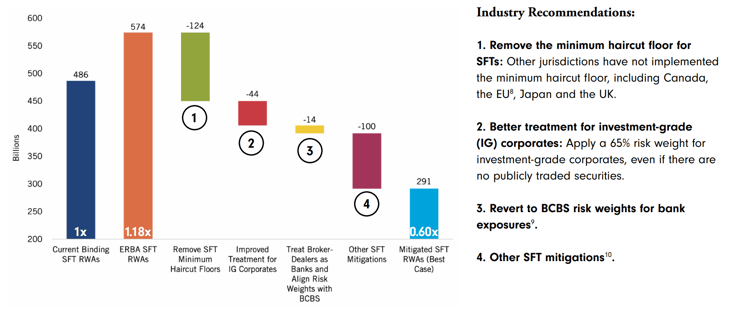
Given the output floor level of Tier' 1 MRC is due to rise from 55% in 2024 to 72.5% in 2028, and MRC is due to increase by 1.9% in the new regulations, capital for securities finance transactions is expected to rise by 18%. Global systemically important banks (G-SIBs) are in for significant challenges, including:
- A 9% increase in common equity Tier 1 capital requirements;
- The new Expanded Risk-Based Approach, potentially increasing RWAs by 20%; and
- Changes to minimum haircut floors.
In this environment, as regulators oblige firms to put aside more capital to cover activities that generate more risk, clients will need more sophisticated tools to manage the new capital requirements and risk calculations.
 Source: ISDA, US Basel III End Game: Trading and Capital Markets Impact, p. 4
According to ISDA’s US Basel III End Game: Trading and Capital Markets Impact article, the rise will be predominantly in RWA treatment, where the challenge is standardized treatment, resulting in higher counterparty risk weights, security risk weights & minimum haircut floors, as well as lower transaction net offs. The article further provides industry recommendations to reduce the SFT RWA impact by 40%.
Pirum's CollateralConnect solves for this scenario, helping firms to manage and deploy their capital more efficiently, thereby improving profitability. By helping clients to utilize the cheapest collateral, thus reducing liquidity capital metrics and optimizing for LCR, NSFR, Leverage Ratio, MRC, CET1 ratio and RWA, CollateralConnect can minimize the negative P&L impacts.
Increased overheads
Before the ‘Basel’ regulatory regimes, the amount of capital required to support operations was an internal decision and metric. Basel III changed that by obliging firms to record anything that generates a loss over a 10-year period as part of their required capital. Moreover, the share of operational risk in the Minimum Required Capital has increased significantly from 8.5% June 2011 to 15% in June 2024.
If a firm incurs an operational loss, for example, due to a manual error when processing a corporate action, that penalty and loss end up on the firm’s capital expenditure and, therefore, their charge number. The same goes for anything that generates an operational loss, including settlement fail penalties and charges from missed recalls.
Pirum’s post-trade solutions can help prevent such costly operational losses. CoacsConnect automates income claims and voluntary corporate actions, while Recalls Manager automates the entire recalls life cycle, helping firms to do business more efficiently.
Improving data quality, integrity, and processing capabilities will also be crucial under the new framework. Likewise, comprehensive reporting tools will be required to help clients meet the new Basel III Endgame reporting requirements.
Pirum has a long and successful track record as a valuable compliance partner. We solve for both collateral efficiency and operational efficiency, resulting in minimized capital charges and operational costs, which translates into maximized P&L, optimized financial resources and healthier operational models.
In summary, CollateralConnect is designed to increase clients’ time, budget and resources, so that they can refocus on growing their businesses.
Want to talk with James or Duncan about how Pirum solutions can make your firm more profitable? Get in touch.