
The AI virtuous cycle in securities finance
BCG’s March 2026 research identifies a virtuous cycle that separates AI leaders from the rest of the market: lower costs fund deeper investment, which unlocks further efficiencies. In securities finance, that cycle has a specific stage - and firms that complete it gain a compounding operational and commercial advantage.
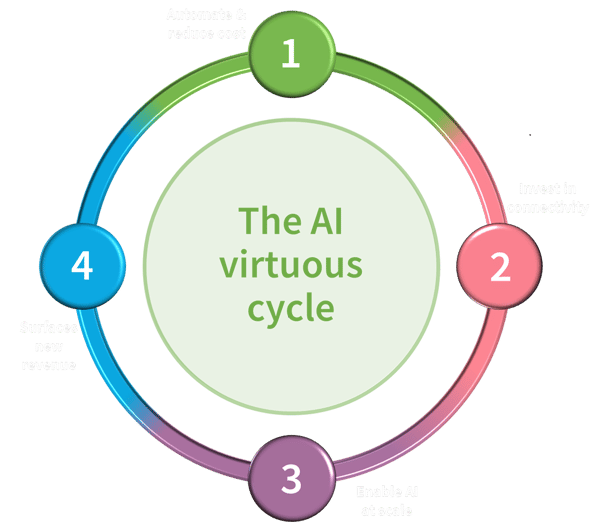

Automation eliminates operational cost
End-to-end automation - recalls, returns, marks, collateral substitution, settlement instruction management; removes the manual overhead that drives settlement fails, CSDR penalties and overdraft charges. STP rates above 99% are operationally and commercially transformative.

Savings fund connected lifecycle infrastructure
Efficiency gains free budget and bandwidth for the connectivity investment that matters; pre-trade to post-trade, across asset classes, standardized and real-time. This is the data foundation without which no AI program delivers at scale.

Connected data enables AI to function
Clean, standardized, enterprise-wide data makes AI viable. Settlement fail prediction, exception triage, collateral optimization, and agentic workflows all depend on the same underlying infrastructure.

AI surfaces new revenue and infrastructure
Intelligence layers - pricing signals, rate anomalies, re-rate triggers, collateral substitution recommendations - surface opportunities that generate incremental revenue and fund the next iteration of the cycle.

BCG (March 2026): 70% of AI’s impact comes from changing how work gets done - not the technology itself. The cycle above is an operating model change, not a procurement decision.

Riverbed (Feb 2026): 92% of financial services decision-makers agree improving data quality is critical to AI success - yet only 43% are fully confident in their data today.